

Dubai’s real estate market offers unmatched opportunity—but also demands sharp judgment. With off-plan launches booming and overseas interest surging, not every “great deal” is what it seems. Whether you’re a first-time investor or seasoned buyer, here are 7 red flags to watch for in Dubai property deals—and how to avoid them.
1. Too Good to Be True Pricing
🚨Red Flag: Properties marketed significantly below market value—especially in prime areas.
Why it’s risky: This could mean unfinished projects, poor location access, or a bait-and-switch tactic.
What to check:
- Compare listings via DXBinteract.com, Property Monitor, or Bayut’s Market Reports
- Ask: “What’s the catch?” If the price is 20–30% lower than average, dig deeper.
Example: Some off-plan launches have advertised AED 600/sqft in areas with an average of AED 950/sqft—only to reveal extended handover dates or poor connectivity.
2. No DLD Escrow Account for Off-Plan Projects
🚨 Red Flag: Developers not registered with Dubai Land Department (DLD) or lacking a mandatory escrow account.
Why it’s risky: Your funds may be unprotected, especially in case of delays or abandonment.
What to do:
- Verify the project on the DLD portal
- Confirm escrow account registration and construction progress reports
📌 Law note: Under Law No. 8 of 2007, all off-plan payments must go into a project-specific escrow account regulated by RERA.
3. Unknown or Unvetted Developers
🚨 Red Flag: Companies without a track record—or ones offering “launch discounts” with no prior delivery record.
Why it’s risky: New developers may face funding, delivery, or quality challenges.
What to check:
- Google the developer + “delays” or “reviews”
- Look up past handovers and timelines on Property Finder or Bayut
- Check DLD’s developer licensing status
📌 Investor Tip: Stick to names with a 3+ project completion history, or partner with Desertfox for vetted listings only.
4. Ambiguous Unit Titles (Freehold vs Leasehold)
🚨 Red Flag: Vague information about property ownership type or confusing title rights.
Why it’s risky: Leasehold titles (especially under 30 years) reduce resale value and bank financing options.
What to verify:
- Ensure the unit is in a freehold zone (e.g., Business Bay, Downtown, Meydan, JVC)
- Ask for a copy of the title deed or reservation form before payment
📌 Quick fact: Only freehold properties can be owned outright by expats.
5. Inflated Rental Yield Promises
🚨 Red Flag: Guaranteed ROI ads offering 10%+ yields in areas where actual ROI is 6–7%.
Why it’s risky: Overpromised rental returns often rely on unrealistic occupancy or rent pricing.
How to respond:
- Ask for proof: actual rental contracts, occupancy history, or yield reports
- Check Area ROI averages on Bayut or DXBinteract
📌 Example: Some developers inflate expected ROI using gross yields, not net returns after service charges or management fees.
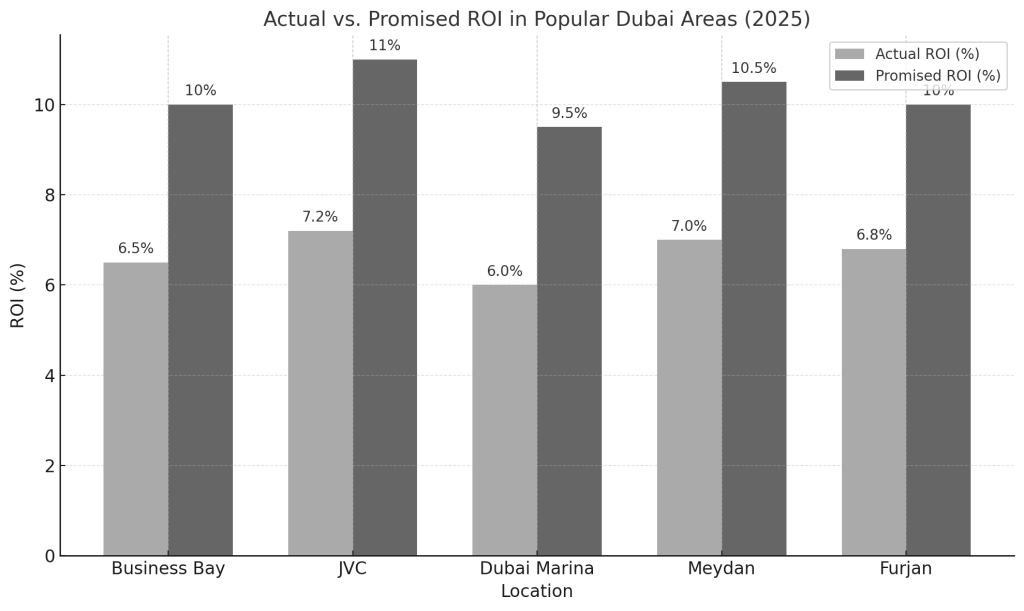
comparison chart showing actual ROI vs. commonly overpromised ROI in key Dubai areas
6. No Completion Timeline or Handover Date
🚨 Red Flag: Contracts with vague or open-ended delivery dates (“subject to market conditions”).
Why it’s risky: You may wait years without penalty or refund recourse.
What to confirm:
- A signed Sales Purchase Agreement (SPA) with a realistic handover year
- Construction update access from RERA or project marketing team
📌 Investor Tip: Projects without a realistic 2–3 year timeline are high-risk. Stick with developers that post quarterly progress updates.
7. No Exit Plan or Resale Support
🚨 Red Flag: No clear guidance on how/when you can resell the unit, especially during construction.
Why it’s risky: You could be locked into a property with low liquidity or transfer restrictions.
Ask upfront:
- Is there a resale clause?
- Can I sell before handover?
- Are there NOC or transfer penalties?
📌 desertfox Advantage: We advise all clients on exit strategies, from short-term resale to long-term holiday rental conversion.

![Where Are First-Time Buyers Purchasing in Dubai Right Now? [2025 Guide]](https://desertfox.ae/wp-content/uploads/2025/07/Where-Are-First-Time-Buyers-Purchasing-in-Dubai-Right-Now-2025-Guide-592x444.png)
